GOD SAVE THE SHOE
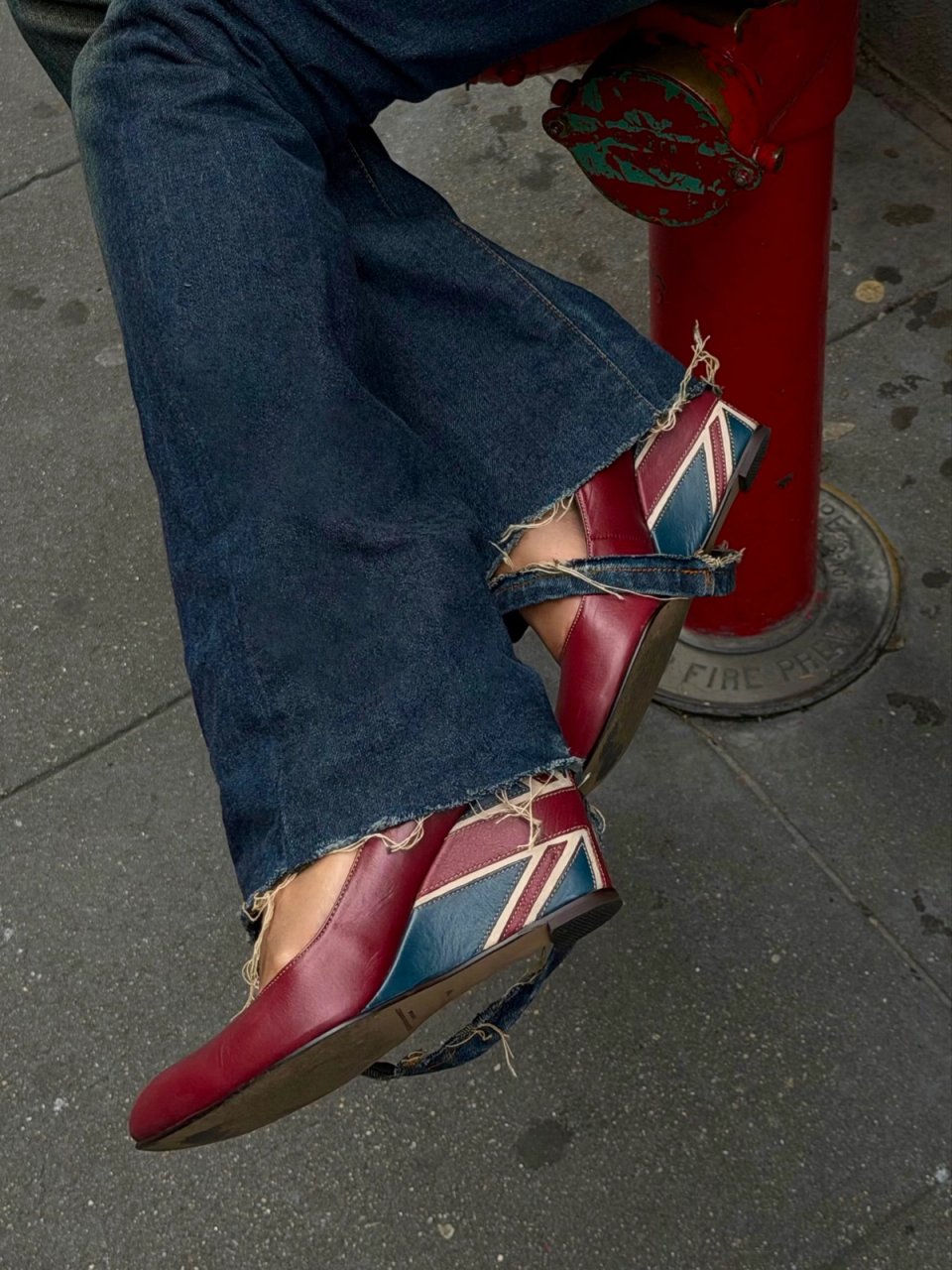
Katharine Hamnett’s Union Jack wedges prove that Britain’s most recognizable symbol was never just a flag.
A good fashion symbol does more than tell you where something comes from. It carries an attitude. It can be political, rebellious, nostalgic, glamorous, or deliberately loud. Few symbols have managed all of that quite as effortlessly as the Union Jack.
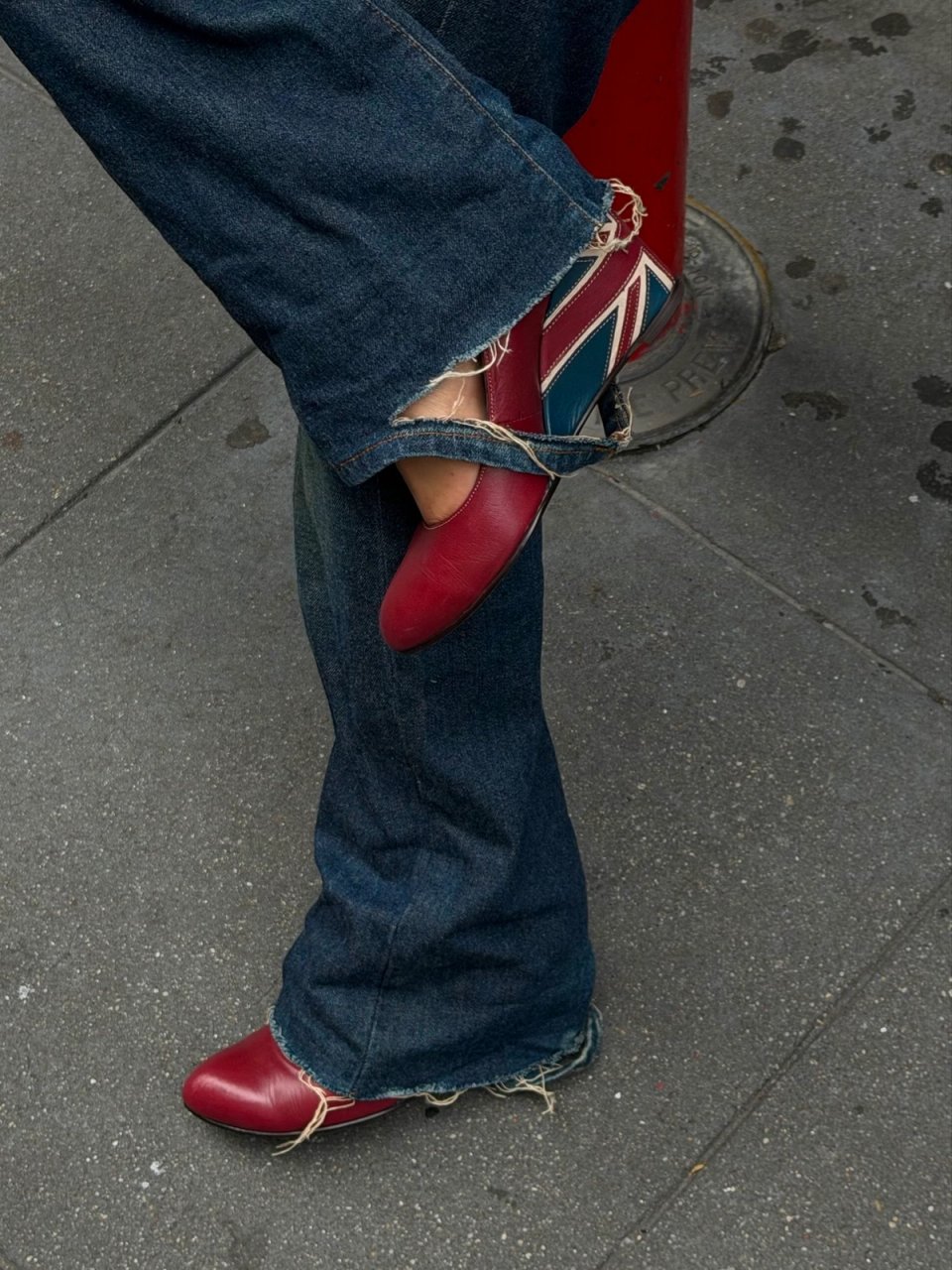
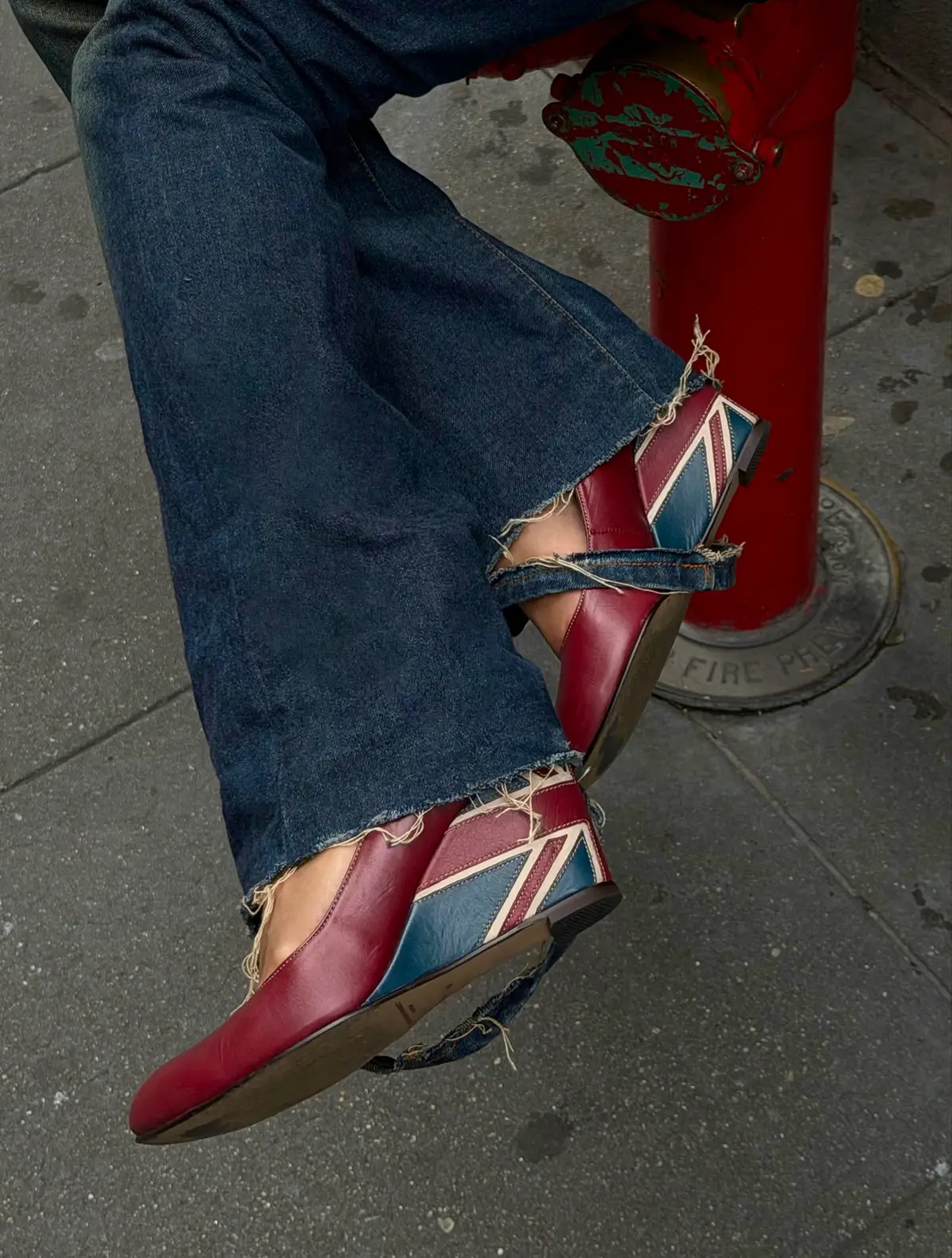
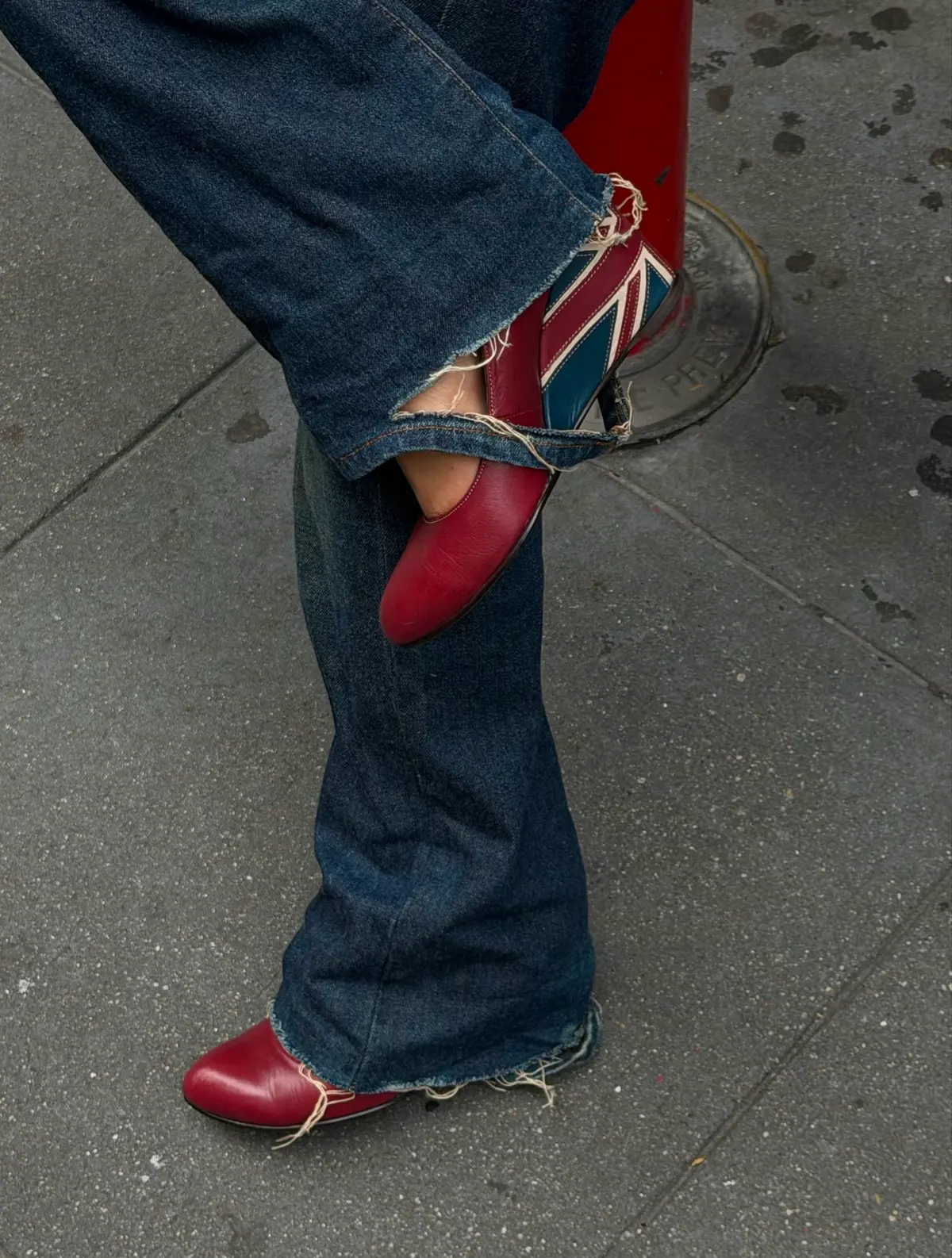
Now back in the Into Archive showroom, Katharine Hamnett’s 2000s red leather wedge pumps put the British flag front and center. Covered in a bold Union Jack motif and finished with a sculptural wedge silhouette, the shoes are unmistakably Hamnett: graphic, confrontational, and impossible to ignore.
But the story behind the shoes goes much deeper than a great pair of vintage heels.
THE FLAG BECOMES THE LOOK
The Union Jack has long existed somewhere between national emblem and pop-cultural shorthand. In fashion, that distinction became especially interesting in the second half of the 20th century, when British designers began turning familiar national symbols into visual statements.
Katharine Hamnett was one of the designers who understood the power of a graphic message. Since establishing her label in 1979, Hamnett became known for using clothing as a vehicle for political and social commentary, particularly through her oversized slogan T-shirts. Her designs made the message impossible to miss: fashion could be wearable, but it could also say something.
The Union Jack fits naturally into that language. It is instantly recognizable, highly graphic, and loaded with associations. Put it on a T-shirt, jacket, bag, or shoe and it stops functioning purely as a national symbol. It becomes an image.
That transformation is exactly what makes these wedges so interesting.
FROM PUNK TO POP
The Union Jack’s fashion history is inseparable from Britain’s musical and youth cultures.
During the 1970s and ’80s, the flag became closely associated with the visual language of British punk, New Wave, and the broader rebellious energy surrounding London. Designers and artists were interested in taking symbols of British identity and making them feel disruptive rather than traditional.
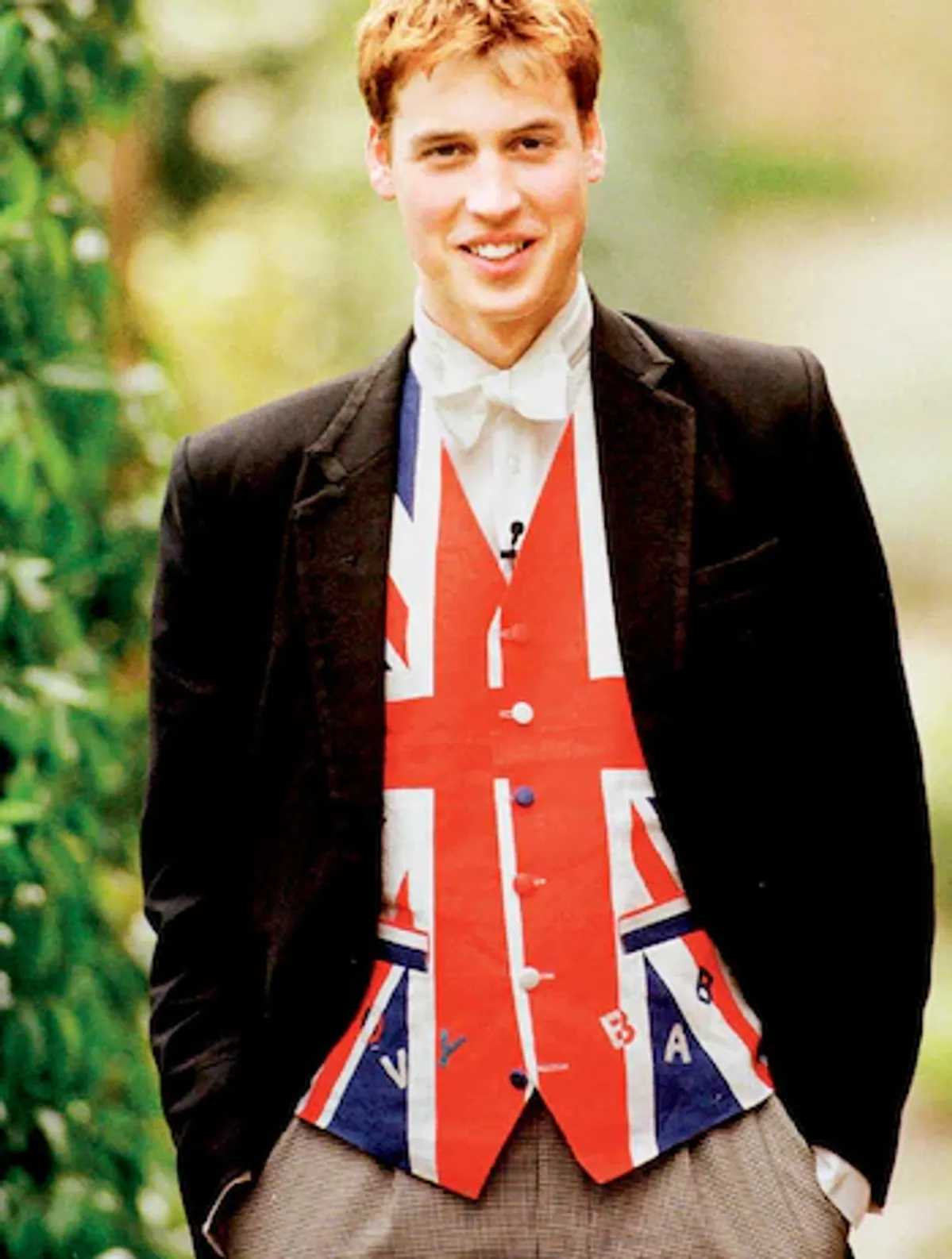

By the 1990s and early 2000s, the Union Jack had entered an entirely different cultural space. It could signal punk, pop, nostalgia, celebrity, or simply an exaggerated idea of British cool.
Fashion embraced the contradiction.
The flag could be patriotic without being conservative, nostalgic without being traditional, and kitschy without losing its edge.
That versatility is part of the reason it keeps returning.
KATHARINE HAMNETT’S TAKE
Hamnett’s Union Jack pieces sit comfortably within this history because her work has always been interested in the tension between fashion and messaging.
Rather than treating the flag as a quiet detail, these pumps make it the entire point. Red leather provides the base, while the Union Jack stretches across the shoe in a graphic, almost poster-like composition. The wedge adds another layer of drama, turning what could have been a simple printed motif into a distinctly early-2000s fashion object.
There is something particularly fun about seeing the Union Jack on a shoe. A flag traditionally belongs somewhere stationary: on a building, a pole, a uniform, a passport. Fashion takes it somewhere else.
You walk in it.
WHY THE UNION JACK KEEPS COMING BACK
Fashion has a habit of recycling symbols, but some motifs have more cultural mileage than others.
The Union Jack is one of them because it can be endlessly reinterpreted. Its bold geometry works naturally in graphic design, while its cultural associations give designers plenty to play with. It has appeared across clothing, accessories, album artwork, advertising, interiors, and street style, moving between subcultures and mainstream fashion along the way.
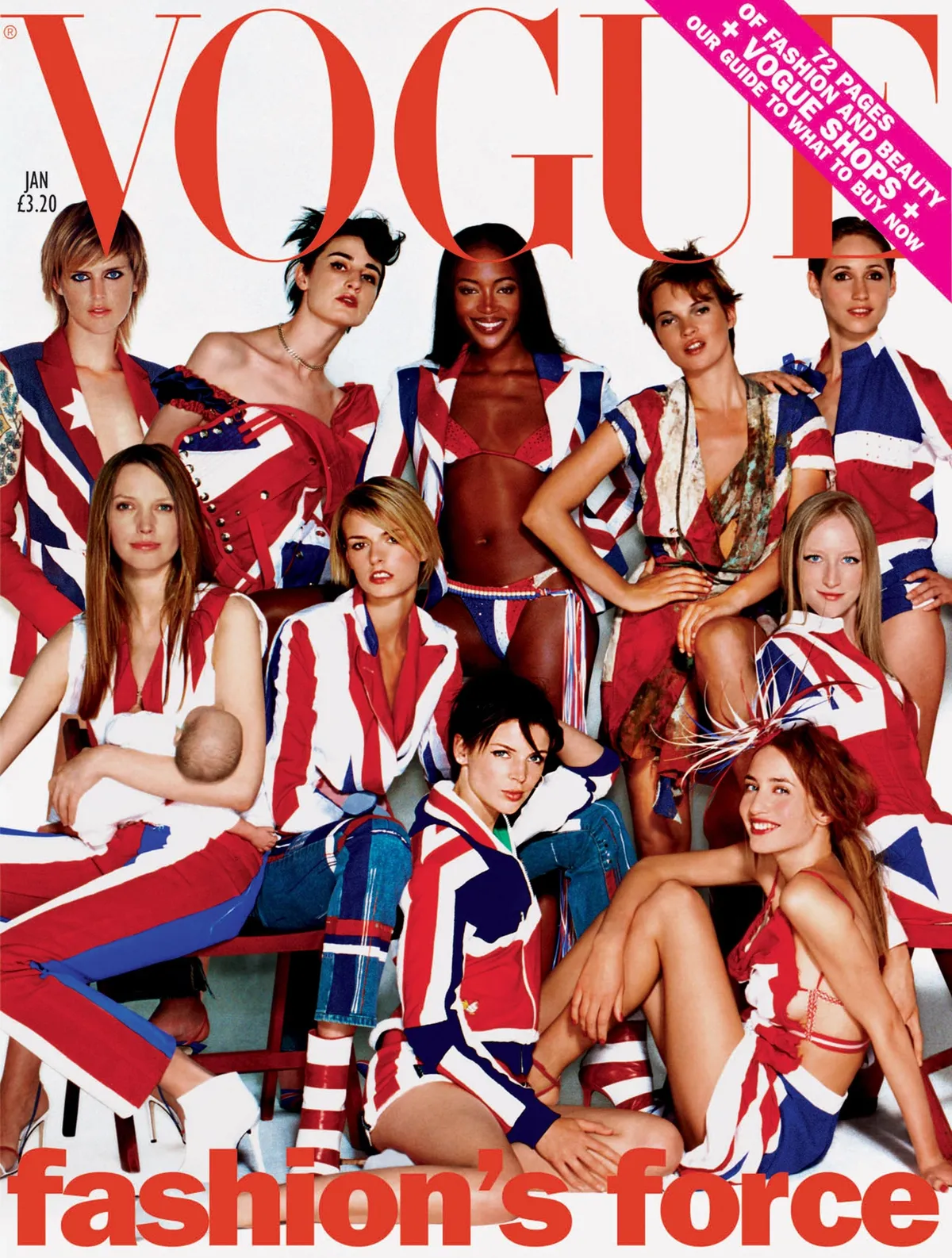
It also has a particularly complicated relationship with nostalgia.
For some, the Union Jack immediately recalls Swinging London, British rock, punk, or the cultural optimism of the late 20th century. For others, it represents a more theatrical version of Britishness: red telephone boxes, music, royal imagery, and London itself.
Fashion can take all of those references and compress them into one object.
That is what makes a piece like Hamnett’s wedges feel surprisingly contemporary decades later. The reference is familiar, but the styling possibilities are constantly changing.
THE EARLY-2000s ATTITUDE
There is also something unmistakably 2000s about the shoes themselves.
The era loved a statement. Logos were bigger, silhouettes were more exaggerated, and accessories often carried as much visual weight as the clothes they were paired with. A pair of Union Jack wedges fits perfectly into that maximalist approach to dressing.
Today, that same quality reads differently.
As fashion continues to revisit the late ’90s and early 2000s, pieces that once felt excessively bold can suddenly look exactly right. The Union Jack is no longer simply a reference to Britishness; it becomes part of the larger language of archival fashion, where context, rarity, and cultural history make an object more interesting.
And these are definitely not quiet shoes.
FROM NATIONAL SYMBOL TO ARCHIVAL ICON
What makes the Katharine Hamnett wedges worth revisiting isn't simply that they feature the Union Jack. It is the fact that they capture several different moments in fashion at once: British punk's visual language, Hamnett's history of political design, the maximalism of the 2000s, and today's fascination with archival pieces.
The flag has changed meaning depending on who is wearing it, where it appears, and how it is styled.
That is the magic of fashion symbols. They rarely stay still.
A flag can become a print. A print can become a statement. And eventually, a statement can become an archival piece worth hunting down decades later.
So, yes: God save the shoe.
→ Rent the Katharine Hamnett 2000s Red Leather Union Jack Motif Wedge Pumps
→ Book a private showroom appointment
Into Archive is a global destination for rare and archival fashion, bringing together collectible pieces from leading designers, independent collectors, and international vendors. Visit our New York showroom by appointment to explore the archive in person.